A mesh office chair in a dark Surabaya workspace, warm tube light raking across the mesh back

Chair guide · SolidShift Ergonomics, Surabaya

How to choose an ergonomic chair

Most chair advice lists features without saying which ones change your working day. This guide works the other way: start with the adjustments that matter, then decide what to spend.

The four adjustments that matter most

Seat height adjustment sets the base of everything. With feet flat and knees roughly level with your hips, your thighs should rest without pressure behind the knee. If the chair cannot reach that height for your body, nothing else on it will compensate — not a deeper seat, not a softer cushion.

Lumbar support depth and height come next. The pad should meet the inward curve of your lower back, not press above or below it. Adjustable lumbar support lets you move it to the right place; a fixed curve either fits you or it does not, and there is no adjusting around it.

Armrest adjustment matters more than people expect. If the armrests are too high your shoulders lift; too low and you lean to one side to find the support. You want them holding the forearm lightly with the shoulders relaxed and the elbows near a right angle.

Backrest recline, even a small range, lets you change position during the day. A chair locked fully upright is harder to sit in for long stretches, because it leaves you nowhere to move.


Seat depth and why short and tall users diverge

Seat depth is the distance from the front edge of the seat to the backrest. Too deep, and the front edge presses behind your knees. Too shallow, and your thighs take the load without support under them.

Shorter user

Shallower seat or sliding pan

Two to three fingers of clearance between the seat edge and the back of your knee is the common guideline. If your legs are shorter, a shallow seat or a sliding seat pan keeps that gap instead of forcing your knees forward.

Taller user

Deeper seat, forward pan

Longer thighs need a deeper seat with a forward-adjustable pan, so the backrest still reaches your lumbar curve while the front edge stays clear of the knee. Measure from the back of your knee to the back of your hip before you compare listings.

Why it decides

A personal number, not a spec sheet number

Seat depth is one of the few specifications where the right answer is genuinely personal. That is why we treat it as a starting filter rather than a detail you fix later.

Handed to the next desk

Fit is checked against your own measurements, not against how many stars a listing has.

Buyer ratings and review counts are more useful for spotting durability problems than for deciding fit. A chair that many people find comfortable may still be the wrong height for you.

Learn about lumbar support
Close macro of a mesh office chair back with a curved lumbar support edge under warm light

Mesh back or padded back

Mesh backs improve airflow and tend to feel better in warm, humid conditions. That is a real advantage in Indonesia, where a padded back can trap heat through an afternoon at the desk.

Padded backs can feel softer against the spine and may suit people who find mesh edges uncomfortable. The trade-off is temperature: if you run hot, mesh is usually the more comfortable choice, and if you work in strong air conditioning, padding is fine.

Seat cushioning is separate from the back. A firm, breathable seat usually holds up better over long sessions than a very soft one that compresses under you by mid-afternoon.

The jump that changes daily comfort most is usually from a fixed back curve to adjustable lumbar support.

What headrests and footrests actually do

A headrest helps if you recline and want neck support in that position. If you sit upright most of the day, a headrest often just sits behind your head unused. It is not a required feature, and paying for one is a choice about how you sit rather than a mark of a better chair.

A footrest matters when your feet do not rest flat on the floor after the chair is set to the right height, which is common for shorter users. Some taller users also use one to shift hip angle through the day. A chair with a built-in footrest can suit long work-from-home sessions where you change position often.

Reading marketplace listings

Local marketplace listings for ergonomic chairs vary widely in how much useful specification they include. Many lead with appearance and leave out seat depth, the lumbar adjustability range, or the armrest height range. When those details are missing, treat the listing as incomplete rather than assume the feature is there.

What the reviews are for

Ratings and review counts are more useful for spotting durability problems than for deciding fit. Read for repeated complaints about the gas lift, the armrest caps, or the mesh sagging, and check the adjustment ranges yourself.

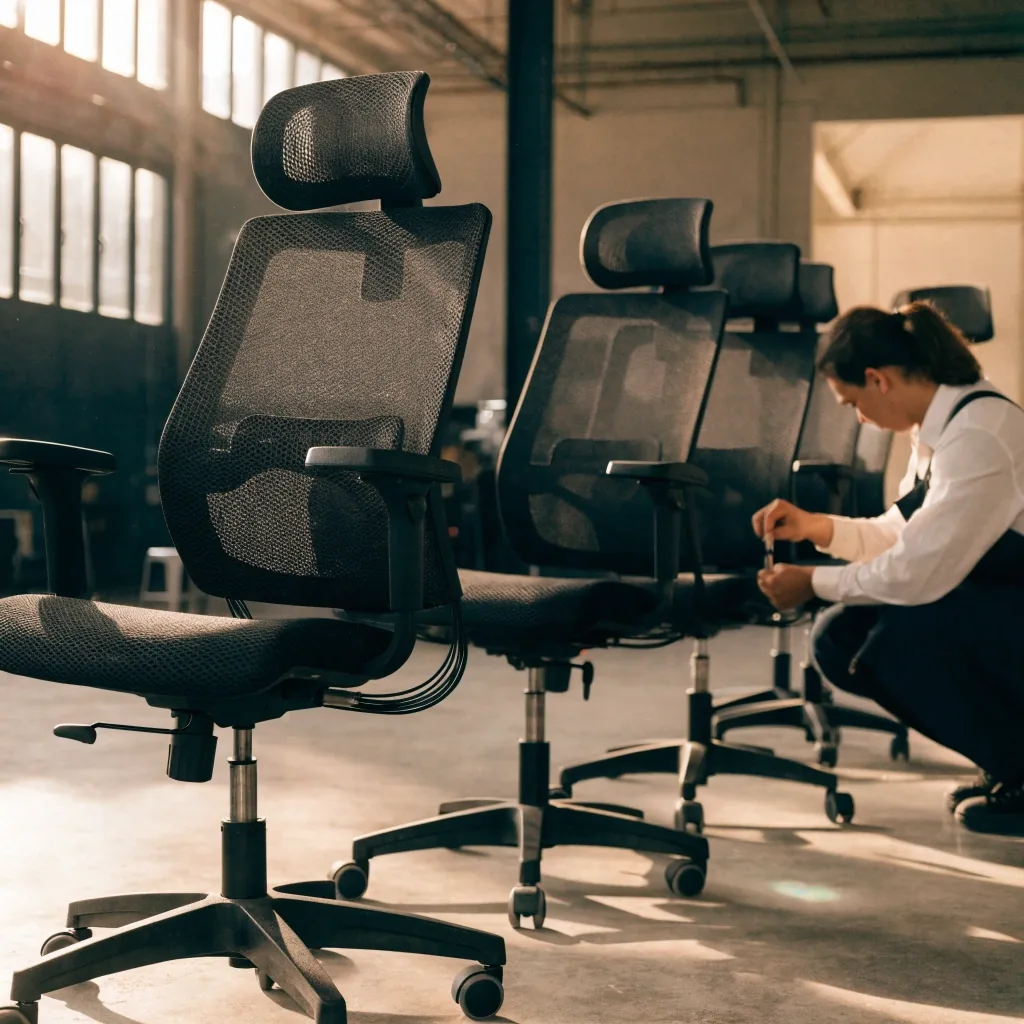
Ergonomic chairs with mesh backs lined along a workshop bench under warm light

Imported chairs and the local market

Cross-border retail listings have made imported ergonomic chairs easier to find in Indonesia, and they have raised expectations about what a midrange chair should offer. Seeing models with adjustable lumbar support and headrests at accessible price points changes what buyers compare against.

That pressure has also pushed local and regional furniture makers to market ergonomic design more explicitly. The result is more choice, and more confusion. The adjustment checklist above is how you cut through it: pick the two or three ranges that decide fit for your body, and ignore the rest of the feature list until those check out.

Budget, midrange, and where the money goes

The price bands are not about brand. They are about how much adjustment you get and how long the parts hold their setting.

Budget

Basic height, fixed curve

Expect height adjustment and a fixed back curve. If the fixed curve happens to match your lower back, this band can work; if it does not, nothing else here will fix it.

Midrange

Adjustable lumbar and armrests

This band usually adds adjustable lumbar support, adjustable armrests, and a recline you can lock at more than one angle. It is where most desk workers find their chair.

Higher

Materials and finer ranges

Higher prices buy materials, build quality, and finer adjustment ranges — a seat pan that slides further, an armrest that moves in more directions, a headrest that holds its angle.

The jump that changes daily comfort most is usually from fixed to adjustable lumbar support. If you are choosing where to spend, that is a reasonable place to start.

A short fitting routine before you buy

Sit in the chair if you can. Set seat height first, then check whether your feet rest flat on the floor. Adjust lumbar support to your lower back, then set the armrests under your forearms. Recline slightly and see whether your neck is still comfortable in that position.

If you cannot try it in person, check the adjustment ranges against your own measurements. Seat height range and seat depth are the two numbers most likely to disqualify a chair for your body, so ask for them before you order.

Chair questions we get asked

Short answers to the three questions that come up most often when people compare chairs for a desk-based day.

What is the difference between lumbar support and generic back support?

Lumbar support is contact targeted at the inward curve of the lower back. Generic back support is any contact along the backrest. Adjustable lumbar support lets you place that contact at the height that matches your body, which is the part a fixed curve cannot do.

Is mesh better than padded for hot climates?

Mesh backs improve airflow and usually feel cooler in warm, humid conditions. Padded backs can feel softer but trap heat. Seat cushioning quality matters independently of the back material, so judge the two separately when you sit in the chair.

Do I need a headrest?

Only if you recline and want neck support in that position. For mostly upright sitting, a headrest is optional and often unused. Spend the budget on lumbar adjustment first if you can only pick one.

Questions about a specific chair or your desk setup? Call +62 31 539 6500, Monday to Friday, 9:00 AM – 6:00 PM, or write to [email protected].

Keep going from here

A chair is one part of the setup. The desk height, the monitor position and how often you leave the seat all matter alongside it. SolidShift Ergonomics works from a studio on Jl. Basuki Rahmat in Surabaya, and the rest of the guides pick up where this one stops.

A desk worker standing in a stretch beside a mesh chair in a dim office at the end of the day